
Innovation Is Not Optional: Why I Am Attending TribalScale's TakeOver 2018!
Written by Amrit Sharma

I am excited for TribalScale’s upcoming TakeOver Innovation Conference on Monday, June 11. It’s a one-day conference in Toronto that will bring entrepreneurs and leaders from a diverse set of companies together under one roof to talk all things innovation.
“Uber yourself before you get Blackberry’d.”
In 2011, Marc Andreessen penned an essay in the WSJ that led to the now-famous line, “Software is eating the world.” Well, while some questioned whether that was true back then, 7 years later the verdict is clear. Software is still eating the world in 2018. Amazon, Microsoft, Alphabet (Google), Apple and Facebook are some of the most valuable companies in the world today — and the richest man in the world is Jeff Bezos! Bezos’s personal net worth has increased $40B so far this year. These tech companies are entering new markets and verticals — either through acquisitions (Amazons & Whole Foods) or innovation (Microsoft & AI). That has led companies across every industry to look over their shoulders and scramble to figure out how to stay relevant and compete in an era of exponential change where they can no longer take the status quo for granted. Innovation is not optional.
In Canada, we have seen a spurt of “innovation labs” and “digital factories” across many companies, some are hiring consultants to get insights on the impact of emerging technologies, while others are implementing ideas from books like Salim Ismail’s Exponential Organizations. These moves might seem like companies are going on the offensive and taking innovation by the horns, but I see concern and a defensive strategy. They have realized that either you disrupt yourself or someone else inevitably will. (I can not recommend BOLD by Peter Diamandis strongly enough if you want the blueprint!)
Why Mexicans Don’t Drink Molson
Drake
Justin Bieber
The Weeknd
Cmdr Chris Hadfield
Norm MacDonald
…
Why is it that Canadian artists, actors, stand up comics and astronauts are renowned the world over (even Nickelback is famous) but Canadian businesses are largely unknown outside our country? How many apps on your phone today are made by Canadian companies? Now what about people in the United States, India or Kenya, how many Canada-made apps do they have on their phones? There are some examples, but not as many as we would like.
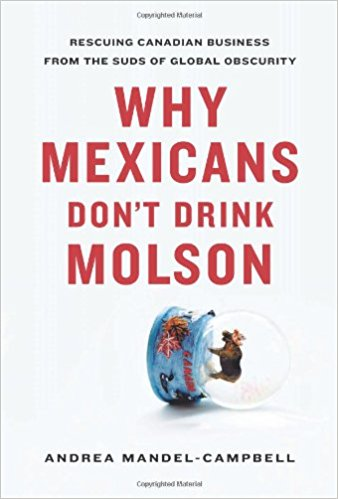
Let’s take beer as an example to discuss Canadian success on the world stage. In Why Mexicans Don’t Drink Molson, author and renowned journalist, Andrea Mandell-Campbell researches and discusses why Molson and other Canadian beers are largely unknown outside of our country. I picked up the book after a glowing review by Wealthsimple CEO Mike Katchen in a talk at TechTO where he encouraged the audience to “think bigger eh?” He said: “One of the ingredients missing in Canada is the idea of naive ambition — trying to build something crazy big without regard for how difficult it will be.”
Canadians breweries could not have asked for more favorable market conditions. The two primary ingredients needed for beer are water and barley. Canada has the largest supply of fresh water in the world, and the second largest supply of barley. So why is it that during my travels I have not once seen Molson on the beer list — whether in Minneapolis, Thimphu, Tokyo or Port Louis? Whereas, Corona dominates pubs worldwide, even though Mexico neither has an abundance of fresh water or barley. I strongly recommend this in-depth Q&A with the author from readers and critics in The Globe and Mail. Among other things, the author finds that Canadian companies have been content to be #1 in Canada and lack the appetite or desire to compete globally.
Similarly, Canada has an abundance of forests but it’s a Swedish company that dominates low cost furniture worldwide with IKEA. Sweden!? Sweden?
I am excited about TakeOver because we need to learn from one another about how Canadian entrepreneurs and companies can break the shackles of this old thinking and embrace the global marketplace where innovation is not optional. If we are going to succeed, we need to transition quickly into a knowledge and information economy, while removing barriers that hinder that, including strategies to overcome a risk-averse and conservative culture that permeates business thinking.
Global Transition from Dirty to Clean
The market conditions for the two sectors (automotive & oil and gas) that Canada has relied heavily on are becoming unfavorable. That’s a whopping 21% of our exports and 10% of our GDP.
The automotive industry is being disrupted by the plummeting costs of batteries and the accelerating price performance of sensors and computing which is leading the rapid adoption of electric and autonomous vehicles.
Secondly, the oil & gas sector has been really good to Canada but the carbon bubble is about to pop. The accelerating transition to cleaner energy sources is inevitable within the next two decades. The cost to produce a unit of energy is already cheaper with solar or wind everywhere in the world, than with coal plants. (If you are curious about this, watch Ramez Naam’s talk from a couple weeks ago at a Singularity University summit in Prague.) We need to transition to these new realities faster than other countries, because it’s all up for grabs. China and India are particularly aggressive in their adoption of solar energy.
Besides these two sectors — um, I don’t know if you have heard of the real estate bubble that we may be in right now, particularly in Toronto. I am not pessimistic because the boom and bust will pass, but it is an additional risk factor that we will have to endure as an economy at some point. Will we continue to invest in our moonshots and innovative ventures that are high risk and high uncertainty during the downturn?
The Next Five Billion Are Coming Online Soon
Enough ink has been spilled documenting China’s rise over the past 30 years and it’s present day dominance on the world stage. But something much more exciting is happening as we speak. There are only 3.7 billion people connected to the internet today. However, initiatives by Google with Project Loon, Facebook with Internet.org, SpaceX’s satellite constellation and others will result in high speed worldwide internet connectivity within the next 7–8 years.
This one trend alone makes me beyond optimistic because this is going to have a massive impact. We won’t be talking about the next billion that has joined the internet, but the remaining 5 billion.
Imagine for a second that a 14 year old girl in Addis Ababa, Ethiopia will have access to the same information that you and I do in Toronto. Plus, she won’t have to buy a $200 tablet for that. Moore’s law trends will have driven usable connected devices to $10–20 by then. It’s what Peter Diamandis calls the “demonetization of everything”. Tablets will become cheap enough for companies like Google to give them away to everyone — not philanthropically — but by making money on the flip side with an ad-supported experience that more than pays for itself.
This is a huge opportunity for entrepreneurs and companies the world over because internet for all means 5 billion new creators, 5 billion new authors, and so on. It’s actually 5 billion new consumers that you and I could not reach before. 5 billion people who are hungry to get this access and make the most of this opportunity after being deprived of it. I am excited and hopeful that this will lead to a more meritocratic and flatter world where people will be judged by the content of their character and the quality of their ideas and execution, rather than the color of their passport.
Can Canadian Companies Innovate?
Sure, they can. Wealthsimple, ecobee and ritual are three top notch startups with their sights set on world domination that just happen to be headquartered in Canada. There are some more companies like them. Plus, companies like TribalScale are filling in the gaps for organizations and bringing them into the future today — successfully!
Some notable examples:
* TribalScale built an Alexa Skill for 1–800-Flowers that integrates with Amazon Pay — one of the first of it’s kind.
* Ecobee built the first wifi-enabled thermostat, and now you can speak to your thermostat with the ecobee4’s built-in Alexa voice assistant.
* Wealthsimple is disrupting the investment industry right here next to Trinity Bellwoods Park.
Market conditions continue to be favorable for Canadian tech companies. But will we step up to the plate and swing the bat this time around with “naive ambition”, unlike our brewery and furniture counterparts? I hope so. Just today, an article in Inc. magazine fawned over Toronto as the next great startup hub. Canada’s proximity to the USA, Alphabet’s Sidewalk Labs, the $950M supercluster initiative, world class universities are just some of the reasons why there is no reason why Canada and Canadian companies can not be known for innovation around the world.
A great wind is blowing and that either gives you imagination or a headache.Let’s Tackle Innovation Together
I look forward to learning from the speakers and panelists at TakeOver, and being inspired by the innovators, leaders and entrepreneurs in the room. I can’t wait to meet you. Please say hello or send me a tweet and we can meet in person at the conference. It takes a village to raise a child, and it’s going to take a village to raise a city’s bar for innovation too. I am glad the village is going to get together on Monday at TakeOver.