
My first 24 hours in Kathmandu after the earthquake
tl;dr — The condition of Kathmandu is much better than I had anticipated and even hoped to find after the M7.8 earthquake
My family and I moved to Kathmandu when I was 2 years old. I spent the next 16 years of my life here. I speak the language and know the streets really well. So when I heard of the M7.8 earthquake and the collapse of the Dharara (white tower) in Kathmandu, I expected the worst.The news and stories from my personal contacts led me to believe that the damage to Kathmandu was apocalyptical.
But instead, I was pleasantly surprised by what I found.
Right away on my first morning here, I set off on foot to look at the damage (or lack thereof) in Kathmandu for myself.
Infrastructure
The roads and bridges are in normal condition. There are no cracks or holes in the roads in the vast majority of the city. Local transportation within Kathmandu goes on unhindered. That’s really good news!
Airport
The TIA was never known for its luxury and comfort. It’s a bare bones international airport that more often than not manages to get flights and its passengers in and out of the country. But after the 7.8 earthquake, I’ve a lot of respect for the airport staff to keep the functional. We (as a country) got lucky that the runways were not damaged by the M7.8 earthquake. That’s remarkable. It would much more difficult to bring in help from anywhere. The TIA is Nepal’s only international airport. Sure, today the airport is dirtier than usual, and there are no auxiliary services available like coffee shops and ATMs. But there’s the occasional taxi to get you to your hotel. And most importantly, commercial, SAR (search & rescue) and relief supply planes are landing and taking off from here. What more can we hope for?
Residential neighborhoods
During the first hour or two hours of my walk around the Baluwatar and Lazimpat neighborhoods, I only saw parts of some walls had collapsed. That’s hardly surprising because walls here are just stacks of bricks, glued together with a little concrete. There’s no foundation or support to these walls. The collapsed walls could have hit passerby’s and cars the earthquake, and are currently a minor inconvenience because some bricks are on the roadside and not cleared away yet. This damage of collapsed walls is minimal and can be easily fixed.
I was surprised by the lack of damage in Baluwatar and Lazimpat. Well obviously, pleasantly surprised. None of the residential buildings in these two neighborhoods have collapsed, and that’s a very good sign for the rest of the city.
Aftershocks and “predictions”
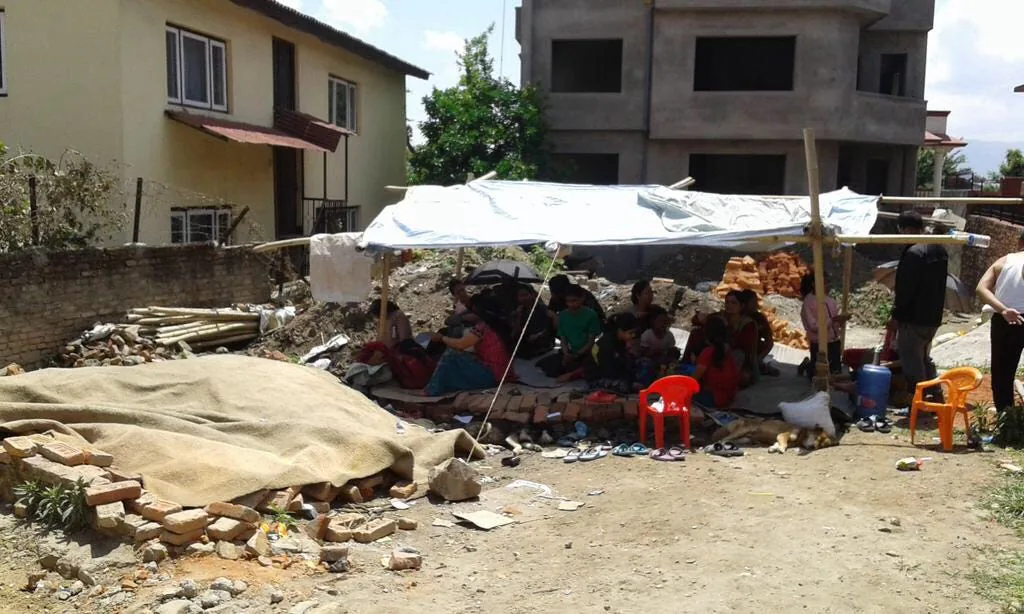
People were sitting together under plastic tarps, as makeshift tents, due to fear of aftershocks. The fear factor among people who experienced the major earthquake was higher than I expected. People were using real time commutation channels like Whatsapp, Viber, SMS and phone calls to spread rumors and “predictions” about upcoming aftershocks and M8 to M11 earthquakes.
I heard first-hand accounts of people fleeing their homes and standing in the middle of the street because they received a phone call from a friend that there will be a big aftershock in the next 10 minutes. And predictions like this often ended with, “Thats what the BBC/NASA just announced.” #facepalm
Temples and Old Neighborhoods
All the residential buildings that were built after the 1970s in Kathmandu, were built of bricks and concrete. Very few of those buildings have been damaged in this 7.8 earthquake. Prior to that, for hundreds of years, the buildings here were made of mud and stone. That goes for the temples and houses. It a tragic loss for Nepal and humanity to see temples crumbling to the ground, and homes becomes dust, but it’s hardly surprising after a 7.8 earthquake in Nepal.
In summary, this is a natural disaster, not an apocalypse. Please treat it accordingly.
That’s my 24 hour update from Kathmandu on Monday, April 27th.
I’m grateful that the earthquake happened on 1158 AM and not PM. There would be a lot more people under the buildings that have collapsed, both in Kathmandu and outside. It would also make search and rescue overnight very difficult.
The weather in Kathmandu has been relatively decent. It seems like we have a heavy downpour every other day.
The people are resilient. Kathmandu and Nepal will rise up from this national disaster, and rebuild again.
It’s time for some Nepali music: Pareli Ma by 1974 AD.